


Using Income Annuities in a Retirement Income Plan: Creating Pension-Like Security with a Laddered Approach
Retirement income planning is about converting savings into a reliable paycheck that lasts a lifetime while protecting against longevity risk, sequence-of-returns risk, and inflation. People who retire with a traditional defined-benefit pension often report feeling more secure, relaxed, and in control during retirement.
The steady, guaranteed monthly check reduces worry about market swings or outliving savings, allowing greater peace of mind and enjoyment of retirement.
Yet only a small percentage of people retiring today have access to a traditional pension. Coverage has declined sharply in the private sector (around 14% of private-sector workers have access to a defined-benefit plan), and overall only a minority of current workers participate in one.
Most new retirees must rely primarily on Social Security plus their own savings in IRAs and 401(k)s.
This shift has left many without the built-in lifetime income that previous generations enjoyed.
Income annuities (single-premium immediate annuities/SPIAs or deferred income annuities/DIAs) can help fill that gap by creating a personal “pension.”
These products transfer longevity risk to an insurer in exchange for guaranteed payments for life (or joint lives).
A laddered income annuity strategy divides the allocation across multiple contracts with staggered start dates. This delivers some income right away, higher payouts later (thanks to mortality credits and deferral), protection against locking in rates at a single moment, and a natural step-up that can help with rising expenses.
Example Couple A
Husband and wife, both age 62, plans to retire at 65 with $1,500,000 in IRA assets and a lifestyle need of $10,000 per month ($120,000 per year). Assume a typical dual-earner Social Security benefit of roughly $3,500 per month combined at age 65 (actual amounts vary by earnings history and claiming age).
This leaves a portfolio gap of about $78,000 per year. Assume a balanced 60% equity / 40% fixed-income allocation at retirement. Dedicating half the fixed-income allocation means using about 20% of the total portfolio ($300,000) for income annuities.
The remaining $1,200,000 stays invested for growth, flexibility, and legacy.
(Figures are illustrative based on mid-2026 market data showing joint-life SPIA payouts near $580–$585 per month per $100,000 premium for a 65-year-old couple; deferred rates are higher. Actual quotes vary by carrier, state, and terms.)
Scenario 1: Traditional Portfolio Approach (No Annuities)The full $1,500,000 remains invested. The couple relies on systematic withdrawals plus Social Security.
Portfolio withdrawal needed: ~$78,000 initially (about 5.2% of assets).
A classic 4% safe withdrawal rate would support only ~$60,000, creating a shortfall. Higher starting rates increase the risk of depleting the portfolio, especially in early-retirement market declines.
Income is flexible and the full principal remains available for inheritance or emergencies.
Drawbacks: No contractual guarantee against outliving assets. Sequence risk and longevity risk rest entirely on the couple. Volatility can force spending cuts precisely when healthcare costs often rise.
Scenario 2: Laddered Income Annuities (Half the Fixed-Income Allocation)At age 65 the couple allocates $300,000 to a ladder of joint-and-survivor (100% to the survivor) income annuities:
Rung 1 – Immediate SPIA ($100,000): Income starts at 65 (~$580–$585 per month joint).
Rung 2 – Deferred income annuity ($100,000): Income starts at 70 (illustratively higher, often in the $750–$850+ range once it begins).
Rung 3 – Deferred income annuity ($100,000): Income starts at 75 (illustratively higher still, potentially $1,000–$1,200+ per month).
Resulting Income Layers (approximate):
Ages 65–69: ~$580–$585 annuity + $3,500 Social Security ≈ $4,080–$4,085 guaranteed. The $1.2 million portfolio supplies the rest at a manageable rate.
Ages 70–74: First two rungs active → higher guaranteed floor and lower portfolio withdrawal pressure.
Age 75+: All three rungs active → potentially $2,300–$2,600+ in annuity income + Social Security, covering a large share of the $10,000 need.
This structure mimics the security of a pension: reliable lifetime income that continues as long as either spouse lives. The rising payouts from later rungs provide a natural hedge against inflation and rising costs, while the remaining invested assets retain flexibility and legacy potential.
Key Advantages
Longevity protection and reduced sequence-of-returns risk.
Growing guaranteed floor that can help retirees feel more secure and relaxed—similar to the experience of traditional pension holders.
Still substantial liquidity and growth potential on the non-annuitized assets.
Trade-offs include limited residual value on the annuity portion (unless a period-certain or cash-refund option is chosen, which lowers the payout), irrevocability of many contracts, and the fact that fixed payments lose purchasing power over time without a cost-of-living adjustment.
Comparison
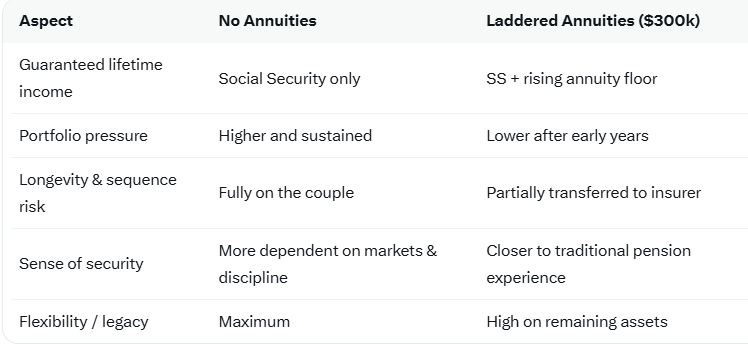
For the majority of today’s retirees who lack a traditional pension, a thoughtfully designed ladder of income annuities can recreate much of that valued security and peace of mind while still preserving growth assets.
Closing Thoughts
Shop multiple highly rated carriers. Coordinate with Social Security claiming, required minimum distributions, and tax planning. Review the strategy periodically. Work with a qualified fiduciary advisor to develop your comprehensive retirement income plan. These examples are educational only.

For over 20 years, John and his team have been helping successful individuals and their families, plan, preserve, protect, and pass on their hard earned wealth.
Based in Naperville, Illinois, John serves clients in Naperville, Plainfield, Darien, Aurora, Geneva, St Charles, and throughout the United States.
Learn more about John's services by visiting https://www.stantongwp.com/team-member-01 or connecting with him on LinkedIn https://www.linkedin.com/in/john-stanton/
Let's Start a Conversation
Have questions? Ready to take the next step? We are here to help! Whether you have specific questions, or are just looking for more information on the above, schedule a call with us today!
Schedule a Call With Stanton Group Wealth
Important Disclosures
This content is for educational and informational purposes only. It does not constitute personalized investment advice, tax advice, legal advice, or a recommendation to buy, sell, or hold any specific security, annuity, or other product. Individual circumstances vary; consult your own qualified advisors before making financial decisions.
State-Registered Insurance Producer / Agent Disclosure (Illinois)
John Stanton is a licensed insurance producer in the State of Illinois, authorized to sell fixed annuities, fixed indexed annuities, life insurance, and long term care insurance. Before recommending or selling an annuity, Illinois law (50 Ill. Adm. Code Part 3120 – Suitability in Annuity Transactions) requires prominent disclosure, on a form substantially similar to Appendix A, of the following:
- The scope and terms of the relationship and the role of the insurance producer in the transaction.
- The products the producer is licensed and authorized to sell (fixed annuities, fixed indexed annuities, variable annuities, life insurance, and any non-insurance products such as mutual funds, stocks/bonds, or certificates of deposit for which a separate license is held).
- The insurers from which the producer is authorized, contracted, or appointed to sell (from one insurer; from two or more insurers; or from two or more insurers although primarily contracted with one).
- The sources and types of cash compensation and non-cash compensation, including whether compensation is by commission (as part of premium or other remuneration from the insurer, intermediary, or other producer) or by fee under a contract for advice or consulting services.
- Notice of the consumer’s right to request additional information regarding cash compensation. Upon request, a reasonable estimate of cash compensation (which may be stated as a range) and whether it is one-time or recurring will be provided.
Annuities are insurance products. Guarantees, including lifetime income payments, are based solely on the claims-paying ability of the issuing insurance company and are not guaranteed by the agent, any bank, or any government agency (including the State of Illinois). Annuities may involve surrender charges, fees, tax implications (including potential penalties for early withdrawal), and other features that should be carefully reviewed. Recommendations are made under the applicable best-interest standard of care.
Product illustrations and rates referenced in this post are approximate, based on publicly available mid-2026 market data, and are subject to change; actual quotes depend on individual circumstances, carrier, and current pricing. This communication is not an offer to sell or a solicitation of an offer to buy any annuity or security. Any discussion of Social Security, withdrawal rates, pensions, or hypothetical examples is for illustration only and does not guarantee results. Readers are encouraged to obtain personalized illustrations, review the full contract and disclosure documents, and consult independent tax and legal professionals.